

Natan Abramov
| 14 min read
What is the best eSIM for Vietnam?
The best eSIM for Vietnam depends on where you are going. For Hanoi, Ho Chi Minh City and the coast, any of the six providers we checked will do, and their fixed plans sit within a few dollars of each other: on November 10, 2026, 10 GB for 30 days cost $17 to $23. For the northern mountains, pick a plan that can use Viettel, which won the coverage award in Opensignal's August 2026 report. Daily plans differ far more than fixed ones: a week of "unlimited" data cost between $12 and $27.50.
Pelesim publishes this blog, so every price below is dated and taken from the provider's own page for you to check. On fixed plans Pelesim did not have the lowest price at 5, 10 or 20 GB in this check, and the table says so. Its case in Vietnam is a different one: it was the only provider whose plans listed Viettel, and its 1 GB a day plans cost less than half of what Airalo, Holafly and Saily charged for the same number of days.
The short version A week or two in cities and beach towns: a 10 GB plan from whoever is lowest on the day. Ha Giang, Sapa or Phong Nha: a plan that lists Viettel, plus offline maps. Three weeks or more: a daily plan at about $1 a day costs less than 20 GB and a top-up.
How much does a Vietnam eSIM cost in 2026?
These are list prices in US dollars from each provider's own Vietnam page, read on November 10, 2026. All are 30-day plans. Yesim shows crossed-out "was" prices beside the ones it charges; the table uses what it charges.
| Provider | 5 GB | 10 GB | 20 GB |
|---|---|---|---|
| Nomad | $10 | $17 | $25 |
| Saily | $10.99 | $17.99 | $28.99 |
| Airalo | $11 | $18 | $29 |
| Yesim | $11.52 | $19.20 | $26.40 |
| Pelesim, VinaPhone network | $12 | $20 | $27 |
| Pelesim, Viettel, VinaPhone and MobiFone | $14 | $23 | $30 |
Nomad had the lowest price at every size. Pelesim's VinaPhone plans were $2 to $3 above it, and its three-network plans $4 to $6 above. Whether three networks are worth that depends on your route, which the next two sections cover.
Two sizes fall outside the table. For 50 GB, Nomad charged $39 and Airalo $49; Pelesim sells no 50 GB plan for Vietnam. Its plan for heavy use is 3 GB a day, at $66 for 30 days. For a short stay, 1 GB for 7 days cost $3.70 at Pelesim on three networks, $3.99 at Saily and $4 at Nomad, and Yesim sold 1 GB valid for 30 days at $3.
Holafly sells only unlimited plans for Vietnam, so it appears in the daily plan table further down. We could not load a Vietnam page on Ubigi's site, so it is not in this comparison.
Which Vietnamese network does each eSIM use?
A travel eSIM has no network of its own. It connects to one or more local networks, and in Vietnam there are four: Viettel, VinaPhone (owned by the state group VNPT), MobiFone and Vietnamobile.
| Provider | Vietnamese networks it lists |
|---|---|
| Pelesim, fixed plans of 1 to 20 GB ($3.70 to $30) and 1 GB daily plans | Viettel, VinaPhone, MobiFone |
| Pelesim, fixed plans of 1 to 20 GB ($4.80 to $27) and 3 GB daily plans | VinaPhone |
| Nomad | Vietnamobile, MobiFone, Vinaphone |
| Airalo | VNPT |
| Holafly | Vinaphone (VNPT) |
| Saily, Yesim | No network named on their Vietnam pages |
Opensignal's August 2026 Vietnam report, built on measurements from April 1 to June 29, 2026, is the best independent read on how those networks compare. Viettel won five awards outright: Coverage, 5G Coverage, Time on 5G, Download Speed and Consistent Quality. MobiFone also won five: Time on Network, Upload Speed, 5G Upload, Video and Voice App. The two tied for Reliability, at 876 and 860 points on a scale of 100 to 1,000, with VinaPhone at 833 and Vietnamobile at 732. VinaPhone's wins were 5G Download and 5G Video. Vietnamobile won nothing and had no 5G results.
For a visitor that reads simply. VinaPhone, which most travel eSIMs use, is a sound network in cities. Viettel is the one with the coverage award, and in this check only Pelesim's three-network plans listed it.
Will it work in Ha Giang, Sapa and Ha Long Bay?
In towns, yes. On the road between them, plan for gaps. Opensignal's coverage award covers the whole country, and we found no operator map detailed enough to promise signal on a particular pass, so treat the list below as how to prepare, not as a measurement.
- Hanoi, Ho Chi Minh City, Da Nang, Hoi An, Hue and Nha Trang. All four networks serve the cities, and a single-network VinaPhone plan is enough.
- The Ha Giang loop, Sapa and Phong Nha. Mountain roads run through valleys and over passes where one network has signal and another does not. A plan that can switch between Viettel, VinaPhone and MobiFone gives your phone three chances at a mast. Download offline maps for the whole route before you leave Ha Giang city or Sapa town, because a map that will not load is the failure that matters on a motorbike.
- Ha Long Bay and Lan Ha Bay cruises, Con Dao and the boat to Phu Quoc. Signal fades with distance from shore on any network. Phu Quoc itself is a built-up island with an international airport; the crossing and the smaller islands are where to expect nothing.

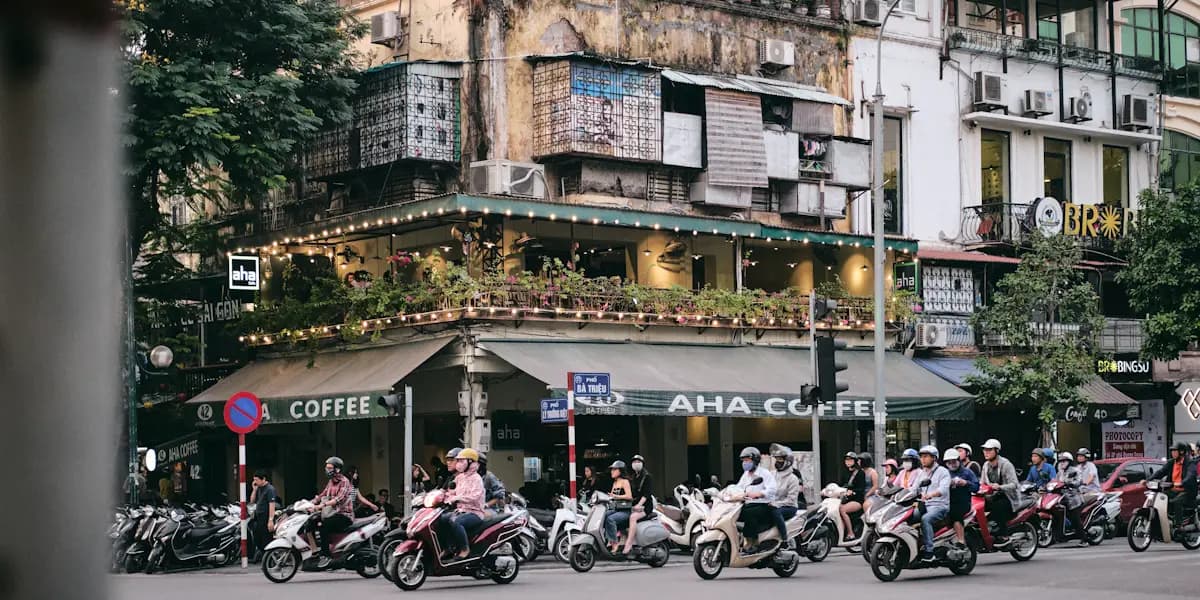
Photo by NAM CZ on Unsplash
If your phone shows bars but no data on a three-network plan, pick a network by hand. On iPhone it is Settings > Cellular (Mobile Data in some regions) > your Vietnam line > Network Selection, then turn off Automatic. On Android, look for Network operators in that SIM's settings. Try Viettel first in the mountains.
Fixed data or a daily plan: which suits your trip?
A fixed plan gives you one pot of data for the trip. A daily plan, sold as "unlimited", gives you an amount at full speed each day and then slows you down until the next day. This is where Vietnam prices spread out:
| Provider | 7, 15 and 30 days | Full speed before it slows |
|---|---|---|
| Pelesim, three networks | $12, $23, $32 | 1 GB a day, then 1 Mbps |
| Pelesim, VinaPhone | $27, $50, $66 | 3 GB a day, then 1 Mbps |
| Airalo | $27, $48, $69 | Its page gives no number |
| Holafly | $27.50, $51.50, $76.50 | No number; its fair use policy can cut speed for up to a day |
| Saily | $48.99 for 15 days | Not shown on the page we read |
| Nomad | $18 for 5 days, $33 for 10 | Its page gives no number |
Prices are from each provider's Vietnam page on November 10, 2026. Pelesim also sells the 1 GB a day plan for a single day at $2.
The comparison is not like for like, and that is the point of the last column. A plan that publishes "1 GB, then 1 Mbps" tells you what you are buying; 1 Mbps still runs maps, messages and a voice call. A plan that publishes nothing may give you more than 1 GB a day at full speed, or less, and you find out in Vietnam.
Against fixed plans the sums are short. The 15-day plan at 1 GB a day costs $23, between a 10 GB plan ($17 to $23) and a 20 GB plan ($25 to $30). A month costs $32 for up to 30 GB at full speed, which is close to the price of 20 GB. So a daily plan suits long trips and steady users, and a fixed plan suits a week of light use.
Which plan fits which trip?
The middle column is our data calculator's estimate for everyday use, about 1 GB a day of maps, messages, social feeds and a few video calls, with a 30% margin. The last row uses its heavy profile of 3 GB a day.
| Your trip | Everyday use | A sensible starting point |
|---|---|---|
| A long weekend in Hanoi or Ho Chi Minh City | 4 to 5 GB | A day plan for each day at $2, or 5 GB |
| One week: Hanoi and Ha Long Bay, or Saigon and the Mekong Delta | 10 GB | 10 GB, or the 7-day daily plan at $12 |
| Two weeks, north to south | 19 GB | 20 GB, or the 15-day daily plan at $23 |
| Three to four weeks with the Ha Giang loop | 28 to 39 GB | The 30-day daily plan on three networks at $32 |
| A month of remote work on a hotspot | Up to 117 GB at heavy use | Pelesim's 3 GB a day plan at $66. Nomad's 50 GB at $39 only if most of the work runs on Wi-Fi |

Photo by Andre Ouellet on Unsplash
Most hotels, hostels and cafes in Vietnam have Wi-Fi, and the real figure drops if photo backups and app updates wait for it. Most providers in this check sell top-ups, Pelesim included, so buy for the trip you expect and add data if you run low.
Should you buy a SIM card at the airport instead?
A local SIM does one thing no travel eSIM in this check does: it gives you a Vietnamese number. It also has to be registered to you in person, and the rules tightened twice in 2026.
| Question | Travel eSIM | Local SIM from Viettel, VinaPhone or MobiFone |
|---|---|---|
| Phone number | None. Data only | A +84 number |
| Registration | None in Vietnam. You buy and install it at home | In person. Since April 15, 2026, carriers must verify each subscriber's identity, including a live photo of the face matched against government records |
| Changing phones | Not subject to these checks | Since June 15, 2026, a SIM moved to another phone has its outgoing service paused within 2 hours until the face check is redone |
| When it works | On landing | After the counter |
Both dates come from Circular 08/2026 of Vietnam's Ministry of Science and Technology, as summarised by the legal database LuatVietnam for new registrations and by the Can Tho city government for phone changes. For a visitor the practical version is: buy at an operator's own counter with your passport in hand, and do not buy a SIM that someone else has already registered. A number registered to another person is the kind the new checks are built to cut off.
We could not read a current tourist SIM price on the operators' own pages, so this guide does not quote one. Many phones take a physical SIM and an eSIM at once, so you can run a local SIM for the number and a travel eSIM for data.
Do you need a Vietnamese phone number?
Most visitors do not. A data-only eSIM covers maps, WhatsApp, Zalo, video calls and ride-hailing apps, and your home number stays on your phone's other line, so codes from your bank and airline still arrive.
Grab is the app people worry about. Grab's Vietnam site says, in a 2018 notice that is still published, that customers on foreign numbers can pay for rides with an international card linked in the app, while its Moca wallet takes only +84 numbers. Sign in at home with your own number, add your card, and you can pay by card or in cash without a local number.
You need a +84 number for a Vietnamese bank account or e-wallet, and for the occasional local app that accepts nothing else. To ring a hotel, a homestay or a bus company that only answers a phone line, a calling app that dials ordinary numbers over your data is enough, for example CallTuv, which is made by the same company as Pelesim.
Are you also visiting Cambodia, Laos or Thailand?
Price it both ways before you buy a regional plan. Pelesim's Asia eSIM covers 19 countries, including Vietnam, Laos and Thailand but not Cambodia, and on November 10, 2026 it cost $26 for 5 GB and $36 for 10 GB over 30 days.
| Route | Country plans, 5 GB each unless noted | Asia plan, 5 GB shared |
|---|---|---|
| Vietnam and Cambodia | $12 + $8.80 = $20.80 | Does not cover Cambodia |
| Vietnam and Thailand | $12 + $6.90 = $18.90 | $26 |
| Vietnam and Laos | $12 + $12 for 3 GB over 15 days in Laos = $24 | $26 |
Country plans were lower on every two-country route, and they give you 5 GB in each country, not 5 GB across both. The regional plan earns its price on a third country or when you would rather install once. Inside Vietnam the Asia plan lists MobiFone and Vietnamobile, not Viettel or VinaPhone, so it is the weaker choice for the mountains. Cambodia plans are sold on their own, and our Thailand eSIM guide has that country's prices and networks.
How do you set it up before you fly?
Install it at home, on Wi-Fi, a day or two before you leave. Pelesim plans do not start counting days until the eSIM first connects to a network in Vietnam, and you have at least 180 days from purchase to install. Some providers start the clock at install, so check that line in the plan details wherever you buy.
- Check that your phone supports eSIM, using our supported device list, and that it is carrier unlocked.
- Buy the plan, then scan the QR code from another screen, or use the install button if you bought on the phone itself. The iPhone install guide shows each screen.
- Name the new line "Vietnam" so you can tell your two lines apart.
- Sort the visa while you are at it. The official e-visa site of Vietnam's Immigration Department says an e-visa is valid for up to 90 days, costs $25 for single entry or $50 for multiple entry, and is not refunded if the application is refused. The same site lists the passports that need no visa and recommends a pre-arrival form to shorten the queue. Any other site charging more is a middleman.
- On arrival, choose the Vietnam line for mobile data and turn on data roaming for that line only. Leave data roaming off on your home line; our guide on whether to turn data roaming on or off explains why that one setting causes most surprise bills.
What changes and what does not?
Prices change. The tables are a snapshot from November 10, 2026, and the order between providers at a given size can flip in a week, so check the date on any comparison you read, this one included.
The local SIM rules are the part still moving. Vietnam tightened subscriber checks in April and again in June 2026, so read anything written about airport SIMs before then with care.
What stays the same is how to choose. Match the network to the route: one network for cities, three for mountains. Then match the plan type to the length of the trip: fixed for a week, daily for a month.
Frequently asked questions
Which eSIM is best for the Ha Giang loop?
One that lists Viettel as well as VinaPhone or MobiFone, because Viettel won Opensignal's coverage award in August 2026 and a second or third network covers some of the gaps the first leaves. In our November 2026 check only Pelesim's three-network plans listed Viettel: $14 for 5 GB, $23 for 10 GB, or $32 for 30 days at 1 GB a day. Whatever you buy, save offline maps before you set off.
Does Airalo or Holafly use Viettel in Vietnam?
Not according to their own Vietnam pages on November 10, 2026. Airalo listed VNPT, the group that owns VinaPhone, and Holafly listed Vinaphone (VNPT). Nomad listed Vietnamobile, MobiFone and Vinaphone. Saily and Yesim named no network.
Is 1 GB a day enough in Vietnam?
For maps, messaging, social media and a few video calls, yes: that is what our calculator counts as everyday use. After 1 GB the plan slows to 1 Mbps until the next day, which still carries maps, messages and voice calls but not smooth video. If you stream or tether a laptop most days, take the 3 GB a day plan or a large fixed plan.
Can I use my Vietnam eSIM as a hotspot?
On Pelesim, yes, on every plan. Saily says it has no hotspot restrictions and Nomad says tethering is supported. Holafly allows 1 GB of shared data a day, and Yesim says it depends on the operator.
Does a Vietnam eSIM come with a phone number?
The Vietnam eSIMs in this check are data only. You can call and message over WhatsApp, Zalo and FaceTime, and your home number stays active on your phone's other line. Saily sells a US number as a paid extra, which is not a Vietnamese number. For a +84 number you need a local SIM registered in your name.
Can I buy an eSIM after I land in Hanoi or Ho Chi Minh City?
Yes, if you can get online to download it, for example on airport or hotel Wi-Fi. Installing at home is easier: a plan that starts on first connection costs nothing to install early, and you walk out of the airport with data already working.
How early can I buy a Vietnam eSIM?
As early as you like within the install window. Pelesim's Vietnam plans can be installed up to 180 days after purchase, and some up to 365 days, and the validity only starts when the eSIM first connects in Vietnam. An eSIM that has not been activated can be refunded within 30 days of purchase.